
Phycocyanin —— A Natural Blue Solution for Powdered Drinks
As U.S. food regulations tighten and the Clean Label movement continues to gain momentum, food and beverage companies are increasingly under pressure to replace synthetic blue dyes with naturally derived alternatives.
In this transition, phycocyanin, a blue pigment extracted from Spirulina platensis, has emerged as one of the most promising and sustainable options for color innovation in powdered beverage formulations.
Celebrated for its natural origin, nutritional benefits, and vibrant clean-label blue hue, this pigment enables brands to meet consumer expectations for transparency and purity while supporting the move toward a cleaner, safer, and more sustainable color portfolio in instant drink applications.
Challenges in Natural Blue Pigments for Powdered Drinks
Compared with synthetic blue colorants, spirulina extract color presents greater formulation and stability challenges in powdered drink mixes.
Key challenges include:
- Limited light heat stability: Phycocyanin, the core component of Spirulina Blue, is highly sensitive to light and heat. During processing or consumer preparation, these factors can cause pigment degradation, leading to color fading or hue shifts from bright blue to greenish tones.
- Phycocyanin storage stability: Its protein-based structure makes it susceptible to environmental stressors, such as humidity and high temperatures, during storage. These factors can trigger oxidation and denaturation, resulting in a gradual loss of color strength and functional activity. Over time, products may show color fading or uneven shade between batches, especially when stored under suboptimal warehouse conditions.
- E-value of phycocyanin variation: The E-value, representing the purity and color intensity of phycocyanin, can fluctuate due to differences in spirulina cultivation, extraction yield, or drying process. Even small variations in these parameters can result in noticeable differences in the blue hue and brightness of the finished product.
- Cost Considerations of Phycocyanin: The Production of natural blue colorants from Spirulina requires more complex processes and stricter quality control than synthetic alternatives. High-quality phycocyanin materials generally come with a higher production cost.
Overcoming these technical and economic barriers is crucial for manufacturers seeking to achieve clean-label blue success in their powdered drink innovations.

Binmei Phycocyanin E10- A Clean Label Blue Solution for Powdered Drinks
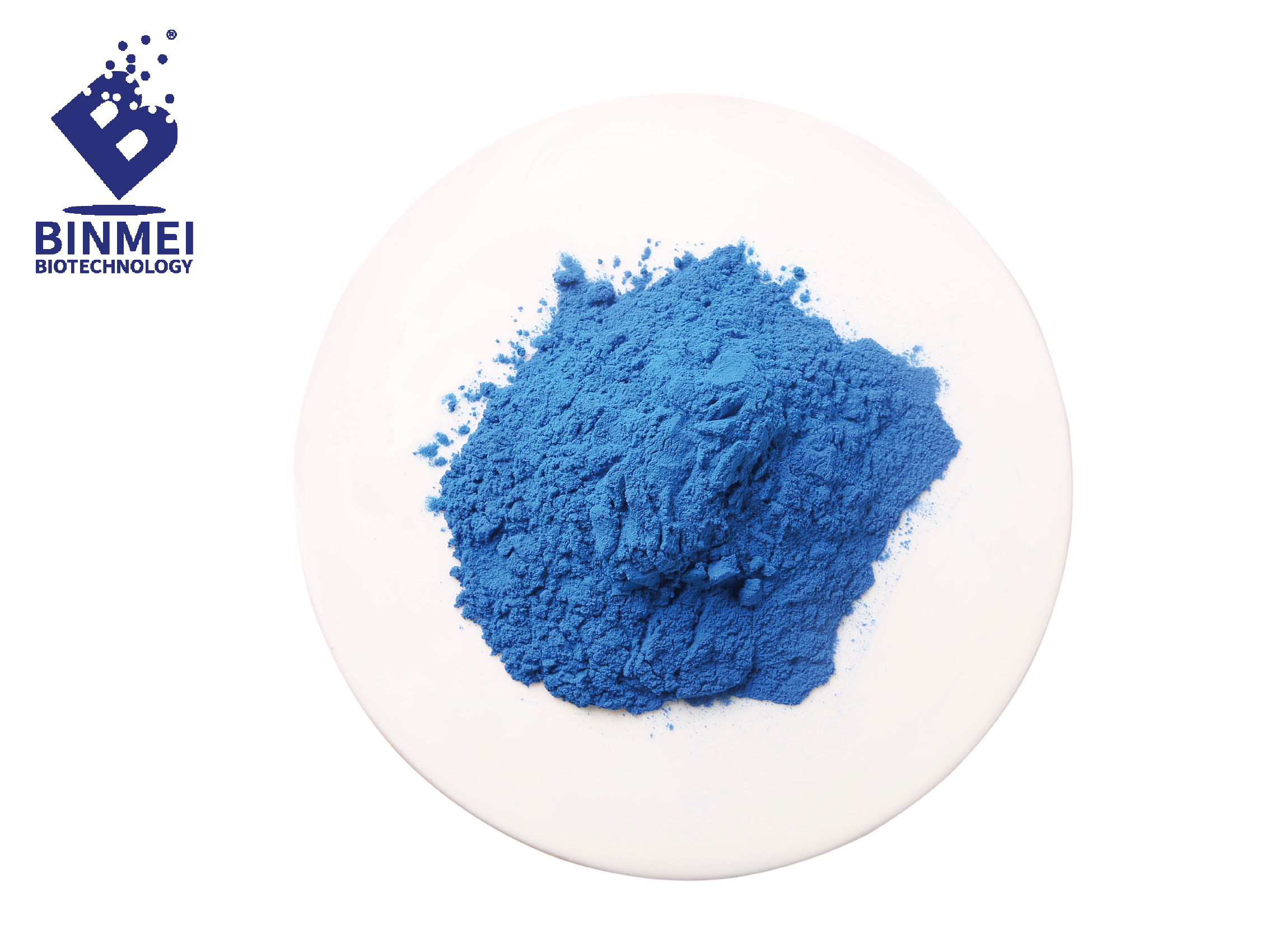
To address these challenges, Binmei has developed Phycocyanin E10, a next-generation natural blue colorant tailored for powdered beverage applications. Combining enhanced stability, excellent dispersibility, and cost efficiency, Phycocyanin E10 provides a reliable and scalable solution, making the replacement of synthetic blue both practical and sustainable.
Key Features:
1 . High color strength and brightness: Optimized purity (E-value) ensures strong, vivid, and consistent blue performance across a wide range of powdered products.
2 . Improved light and phycocyanin storage stability: Demonstrates good light resistance in powder form and retains color integrity, safety, and nutritional properties under proper conditions.
3 . Superior dispersibility and solubility: Engineered through Binmei’s proprietary mixing, sieving, and spray-drying technologies, Phycocyanin E10 remains stable in powdered drink mixes and dissolves rapidly in water, delivering uniform and consistent coloration every time.
4 . Consistent quality and flexible cost control: Customized Mesh size, E-value, and color intensity ensuring consistent quality across batches while achieving an optimal balance between color performance and phycocyanin cost.
Application Recommendations
To further enhance stability in powdered drink mixes, Binmei offers several practical formulation tips:
- Add natural antioxidants or use encapsulation: Incorporating ingredients such as ascorbic acid, tocopherols, or rosmarinic acid—or encapsulating pigments with maltodextrin or gum Arabic—can minimize oxidative degradation.
- Protect from light and moisture: Use opaque, moisture-proof packaging and include desiccants to control humidity.
- Optimize formulation parameters: By maintaining a slightly acidic pH, minimizing heat exposure, and ensuring compatibility with other ingredients.
- Ensure proper storage: Keep finished products in cool, dry conditions and rotate inventory regularly to maintain uniform quality.
Toward a Clean Label Blue Future with Natural Blue Pigments
Through continuous R&D and process innovation, Binmei enables food and beverage brands to realize a truly clean-label blue—a stable, natural, and visually appealing alternative to synthetic colorants.
With Phycocyanin E10, replacing synthetic blues in powdered beverages is no longer just an aspiration—it’s a sustainable reality for innovators shaping the next generation of natural color solutions.
For further technical details or application support, don’t hesitate to get in touch with us.
Previous Post
Big Changes are coming: Natural colors replace Artificial colors in the food industry
Leave a Reply
You must be logged in to post a comment.